


Chiamaci
+86-15105800222
+86-15105800333


A shaking pressure gauge needle is a symptom, not a standalone fault. In most plants, the gauge itself is only reporting what the process, piping, or installation is doing to it. The practical conclusion comes first: do not replace the gauge until you know whether the movement is caused by vibration, pressure pulsation, trapped air, a worn movement, or an incorrect specification. A gauge that shakes at steady pressure usually has a mechanical or installation problem. A gauge that shakes only during pump starts, valve changes, or compressor cycles usually has a process dynamics problem. A gauge that jumps and then settles may have an internal movement issue, a loose pointer, or a damaged bourdon tube.
If the needle trembles continuously while the process is stable, check vibration, liquid fill, and the movement first. If the needle pulses in rhythm with a pump, compressor, or reciprocating valve, check pulsation and add damping or a restrictor. If the needle jumps irregularly and the reading is slow to settle, check for trapped air, a partially blocked impulse line, or a worn movement.
Needle movement has a signature. A slow swing across a wide arc is different from a high-frequency blur. A pointer that vibrates only at 20 percent of scale is different from one that shakes most visibly near the upper end. Maintenance teams get better results when they describe the motion in plain terms before choosing a repair:
Record the pressure at which the shake appears, the machine state at that moment, and whether the gauge is liquid-filled. A glycerin-filled gauge with a visible air bubble behaves differently from a dry gauge, and a diaphragm-sealed gauge on a dirty line can show movement caused by a clogged seal rather than by the instrument. For general utility lines where vibration is moderate and the medium is clean, a robust filled gauge such as a Y60 model is often the first specification to review.
 Y60 Series General-Purpose Pressure GaugeGeneral-purpose gauge for compressed air, nitrogen, oils and other gases or liquids, with a sturdy structure for stable industrial pneumatic and manufacturing use.View Product →
Most field cases fall into a small number of categories. The table below is a practical starting point, not a substitute for inspection. The caption explains how to use it during a site check.
| Cause | Typical needle behavior | First field check | Practical correction |
|---|---|---|---|
| Mechanical vibration | Continuous high-frequency flutter, worse near pumps or compressors | Touch the case and piping; compare shake with machine on and off | Remote mount, flexible impulse line, liquid-filled gauge, vibration-damping bracket |
| Pressure pulsation | Regular pulse synchronized with a pump or reciprocating valve | Watch the needle rhythm against pump stroke or valve cycle | Snubber, restrictor, orifice, pulsation damper, capacitor-style damping |
| Trapped air or steam pocket | Erratic jump, slow response, unstable reading after startup | Check impulse line slope, vent valves, and whether the line is purged | Correct piping slope, add vent or purge point, fill line properly |
| Worn movement or loose pointer | Shake at steady pressure, poor return to zero, visible pointer looseness | Tap the case lightly and observe repeatability; check zero | Recalibrate or replace; do not rely on a worn movement for safety decisions |
| Over-pressure or pressure shock | Sudden jump, shifted zero, bent pointer, shake after a spike | Review recent valve closures, water hammer, and pump start records | Replace gauge, increase range, add surge protection, check restrictor sizing |
| Wrong gauge specification | Shake from first installation, poor readability, short service life | Compare range, fill, wetted parts, and connection with the application | Respecify case, fill, movement, diaphragm seal, or connection style |
The correction should match the cause. A liquid-filled gauge can reduce flutter, but it will not remove a hydraulic pulse caused by a reciprocating pump. A restrictor can smooth a pulse, but it will not repair a bent bourdon tube. A diaphragm seal can protect the gauge from a corrosive or dirty medium, but it can also add response lag if the seal and capillary are poorly selected. The goal is not to make the needle look calm; the goal is to make the reading trustworthy.
These three conditions often look similar on a dial, but they need different fixes. Vibration enters through the case, bracket, or piping and shakes the whole instrument. Pulsation enters through the pressure port as a rapid pressure cycle. Trapped air changes the hydraulic stiffness of the impulse line, so the gauge responds late and then overshoots. If you treat all three as one problem, you may over-damp the gauge and hide a real process issue.
The needle blur remains even when pressure is steady. The case may hum or feel warm from nearby equipment. A remote-mounted gauge or a filled case usually improves the reading immediately.
The needle moves in a regular rhythm. The reading may average correctly, but the pointer is hard to read. A restrictor or snubber changes the rhythm, while a filled gauge alone may only reduce the blur.
The gauge reacts slowly, jumps after a valve change, or reads differently after the line is purged. The impulse line may slope incorrectly or have a high point that traps gas.
The chart is qualitative. It shows where to spend inspection time first, not a guaranteed outcome. A gauge with a worn movement may still need replacement even after vibration and pulsation are corrected, because the pointer mechanism has already lost repeatability.
Start with the instrument family because the same correction is not equally suitable for every gauge. A dry utility gauge, a liquid-filled process gauge, a diaphragm-sealed gauge, and a medical or HVAC gauge have different damping options and different risks.
A dry gauge is simple and easy to read, but it has little internal resistance to vibration. If the gauge is mounted directly on a vibrating pump casing, the movement can wear quickly and the pointer can blur. A practical fix is to move the gauge to a stable bracket, use a flexible impulse line, or change to a filled version. For clean air, water, and non-corrosive utility lines, a filled general-purpose gauge is often the lowest-risk upgrade.
Glycerin or silicone fill damps the movement and reduces pointer flutter. It also lubricates the movement and helps protect against mild vibration. The limitation is that fill does not remove a strong pressure pulse, and it can make the gauge slower to respond in cold conditions. If the process has both vibration and pulsation, use fill plus a restrictor or snubber. A seismic gauge designed for marine, automotive, or heavy machinery service is a better match than a standard dry gauge when vibration is continuous.
 Seismic Pressure Gauge with Damping OilOil-filled gauge for vibration and shock resistance, with luminescent dial for low-light reading and marine protection against seawater and salt spray.View Product →
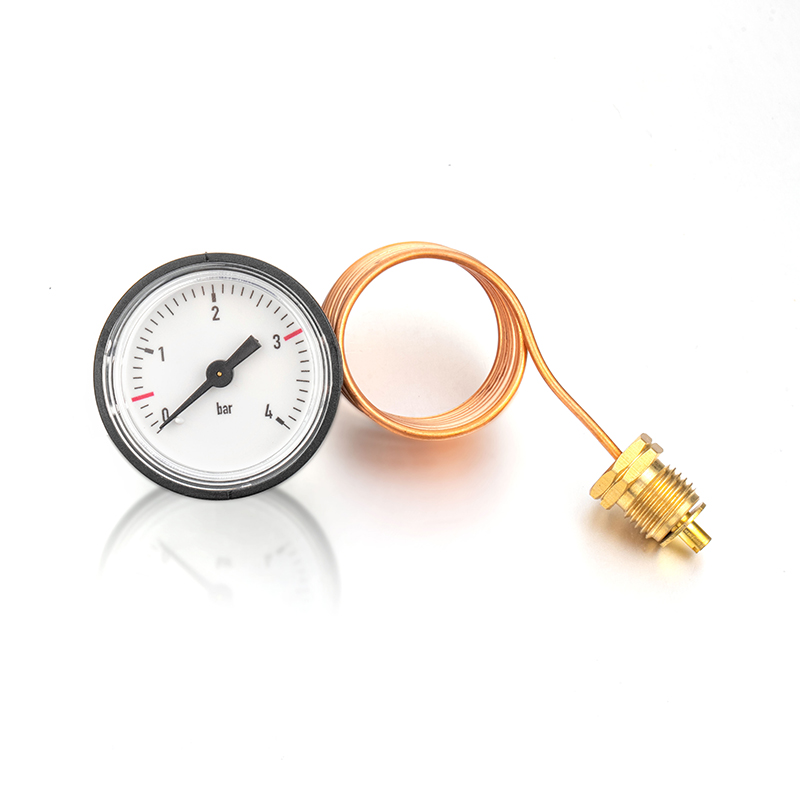
When the medium is corrosive, viscous, crystallizing, or contains particles, a diaphragm seal protects the gauge. However, a seal adds compliance to the measuring system. If the capillary is long or the fill fluid is viscous, the needle may respond slowly and appear to shake during fast pressure changes. Select the seal diameter, fill fluid, and capillary length against the actual response requirement. For a water treatment line with a clogged filter, the shake may be a symptom of pressure instability rather than a gauge fault.
For sludge, slurry, and chemical lines where the gauge must be isolated from the medium, a diaphragm-type gauge is often more appropriate than a standard bourdon-tube gauge. The seal should be sized so that the gauge range still covers the normal operating pressure and the expected pressure spikes.
Diaphragm-Type Pressure Gauge for Corrosive MediaDiaphragm isolation protects the measuring mechanism from corrosive, viscous, crystallizing or solidifying media, supporting stable pressure readings in energy and environmental applications.View Product →Many shaking needles are installed, not manufactured. A gauge mounted on a short direct nipple at a pump discharge sees the full pulse and the full vibration of the casing. A gauge mounted on a long, poorly supported line can see mechanical vibration from the pipe. The impulse line should be sloped, supported, and purged so that it does not trap air or liquid pockets.
A regular pressure gauge maintenance and calibration routine should include a visual check for pointer looseness, case damage, fill-fluid discoloration, and zero return. These checks take less time than a troubleshooting call and often catch a shaking needle before it becomes a safety issue.
Damping is a trade-off between readability and response speed. A gauge that is too heavily damped may look stable but may not show a rapid pressure rise during a fault. A gauge that is too lightly damped may be unreadable during normal operation. The right choice depends on the process, the ambient temperature, and the consequence of a missed pressure change.
| Damping method | Best for | Limitations | Procurement note |
|---|---|---|---|
| Glycerin fill | General vibration, pump and compressor areas, outdoor utility lines | Cold-weather viscosity, slower response, not a cure for strong pulsation | Confirm fill type and temperature range; check case sealing |
| Silicone fill | Wide temperature range, vibrating equipment, applications where glycerin is unsuitable | Higher cost, still not a substitute for a restrictor | Confirm compatibility with the environment and local requirements |
| Restrictor or snubber | Reciprocating pumps, compressors, valve-induced pulses | Can slow response; may clog in dirty service | Size the orifice against pressure and response needs |
| Capillary or remote mount | High-vibration equipment, hot or hard-to-reach locations | Adds response lag; capillary can be damaged if unsupported | Review capillary length, fill fluid, and bracket support |
| Diaphragm seal | Corrosive, viscous, or particle-laden media | Adds compliance; seal may clog if not sized correctly | Match seal material to the medium and cleaning method |
For a clean water line with a moderate pump pulse, a filled gauge plus a small restrictor is often enough. For a chemical line with a diaphragm seal, do not add a restrictor without checking the response time, because the seal already adds lag. For a medical or HVAC gauge, the original specification may rely on a controlled internal damping design, so replacing it with a generic filled gauge can change the reading behavior.
Use a repeatable sequence so that two technicians can compare results. The following steps are written for a plant maintenance team, but the same logic applies to a manufacturer checking a returned gauge.
Some shaking needles cannot be fixed with a restrictor or a bracket because the gauge was never matched to the application. A dry gauge on a vibrating compressor, a standard gauge on a corrosive line, or a low-range gauge on a pump discharge with pressure spikes will continue to fail even after adjustment. Look for these warning signs:
Procurement risk is usually highest when the gauge is bought as a generic item and installed by habit. A small change in range, fill, connection, or seal material can make a large difference in service life. For a manufacturing or engineering team, the purchase specification should state the medium, normal pressure, maximum pressure, ambient temperature, vibration source, mounting orientation, and required accuracy. If those details are missing, the supplier can only quote a general-purpose gauge, and the field will decide whether it was suitable.
Write down the pressure range, the maximum non-shock pressure, the expected pressure spikes, the medium, the ambient temperature, and the mounting location. Add whether the gauge will be filled, whether a diaphragm seal is needed, and whether the connection is direct or remote. This information prevents the most common cause of a shaking needle: a gauge selected for the dial size rather than for the process.
Buyers and maintenance teams can catch many problems before installation. A gauge that shakes in the box may have a loose pointer, a damaged movement, or insufficient fill. A gauge that reads correctly on the bench but shakes in service may be correctly manufactured but wrongly specified. The checks below are practical for incoming inspection and for factory acceptance review.
Incoming inspection does not need to be complicated, but it should be consistent. A simple record of zero position, pointer behavior, and fill condition gives the maintenance team a baseline. If the gauge later develops a shaking needle, the team can compare the current behavior with the baseline instead of guessing whether the problem is new.
Steady-pressure shake usually points to mechanical vibration, a loose pointer, a worn movement, or insufficient damping. Check whether the case or piping is vibrating, then compare a dry gauge with a filled gauge. If the needle still shakes after the gauge is isolated from vibration, inspect the movement and zero return.
No. Liquid fill reduces vibration-induced flutter and improves readability, but it does not remove a pressure pulse. If the needle moves in a regular rhythm with a pump or valve, use a restrictor, snubber, or pulsation damper as well. Over-damping can make the gauge slow to show a real pressure change.
Compare the gauge with a second instrument or a transducer. If both readings shake, the cause is likely in the process or installation. If only one gauge shakes, the problem is more likely in that gauge, its connection, or its mounting. Watching the rhythm against the machine cycle also helps separate vibration from pulsation.
For many mechanical gauges, normal operating pressure should sit between roughly 20 and 75 percent of full scale. A gauge that runs near the bottom of its range may show more visible movement from small pressure changes. A gauge that runs near the top may be damaged by pressure spikes. Select the range from the actual normal pressure and the expected maximum pressure, not from the dial size alone.
Yes. Trapped air changes the hydraulic response of the impulse line, so the gauge may jump, lag, or overshoot. Check the line slope and purge point. In liquid service, the line should vent air back to the process; in gas service, it should drain condensate away from the gauge.
Replace the gauge if the pointer is loose, the zero has shifted after an over-pressure event, the case is cracked, the fill fluid is contaminated, or the gauge cannot repeat its reading after calibration. Repair may be practical for a blocked restrictor or a minor connection issue, but a worn movement or damaged bourdon tube is usually a replacement case.
It can. A shaking pointer is difficult to read, and the average reading may not represent the true pressure. More importantly, the shake may indicate a worn movement, a pressure pulse, or an over-pressure condition that will shorten service life. Even if the gauge still reads within tolerance on a bench test, the installed reading may be unreliable.
Provide the medium, normal pressure, maximum pressure, pressure spikes, ambient temperature, vibration source, mounting orientation, connection size, required accuracy, and whether the gauge will be filled or supplied with a diaphragm seal. A supplier who understands the application can recommend a gauge that will not repeat the same shaking problem.

+86-15105800222
+86-15105800333


Zona industriale di Shuangtang, città di Liuheng, distretto di Putuo, città di Zhoushan, provincia di Zhejiang, Cina
Ti risponderemo entro 12 ore dalla ricezione della richiesta Nei giorni lavorativi. Oppure, chiamaci.
The information provided on this website is intended for use only in countries and jurisdictions outside of the People's Republic of China.
Copyright © Zhoushan Jiaerling Meter Co., Ltd. All Rights Reserved.

